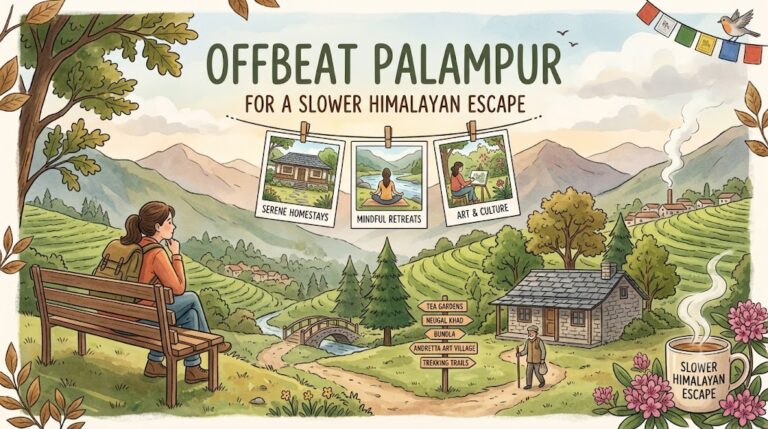
If you are someone like me who feels tired just by looking at long itineraries, then knowing how to plan a mountain trip when you hate overplanning can honestly feel like a relief to you. Not every trip needs spreadsheets, hour-by-hour plans, or endless research. Some of my best mountain memories came from trips where I barely planned anything and just let the place guide me.
I still remember one such trip where I only booked my stay and packed a small bag. No fixed list of places, no strict schedule. And somehow, everything just fell into place. I felt more connected to the mountains because I was not rushing.
So if you also prefer a relaxed, flexible way of traveling, here is how you can plan a mountain trip without overplanning every small detail.
Why does overplanning ruin a mountain trip sometimes?
Mountains are not like city destinations where everything runs on a fixed schedule. Because the weather can change, roads get blocked, and sometimes you discover a hidden spot that was never on your list.
When you overplan:
- You feel stressed about following a timeline.
- You rush through places instead of enjoying them.
- You miss unexpected experiences.
But when you keep things simple, you actually enjoy the silence, the slow mornings, and those unplanned chai breaks with a view.
What is the minimum planning you actually need?
You do not need a full itinerary, but a little basic planning that helps you stay safe and comfortable. Think of it as a loose structure, not a strict plan.
Here is all you really need:
Choose your destination.
Pick one place instead of trying to cover too many, whether it is a quiet valley or a small hill town, and keep it simple.
Book your stay for the first night.
This gives you peace of mind after reaching. After that, you can extend or move depending on how you feel.
Check the weather once.
Just to avoid extreme conditions, you do not need daily forecasts.
Pack smart, not heavy
Carry basics like warm clothes, comfortable shoes, and essentials. Do not overpack “just in case” items at all.
This is enough to get you started without feeling overwhelmed.
How do you keep your trip flexible and still smooth?
The trick is to plan loosely but stay aware. You do not need a fixed schedule, but you should have a rough idea of your days.
What worked for me:
- I kept one or two places in mind each day, nothing more.
- I asked locals for suggestions instead of relying only on the internet.
- I kept extra time in hand for delays or just doing nothing.
Some days, I explored a nearby trail. On other days, I just sat with a cup of tea, watching the clouds. Both felt equally meaningful.
How to choose the right mountain destination for a relaxed trip?
If you hate overplanning, avoid places that are too crowded or overly commercial.
Instead, look for:
- Less crowded hill towns.
- Villages with homestays.
- Places where walking is enough to explore.
These places naturally slow you down, and you do not feel the pressure to “cover everything,” and that is exactly what you want.
What are the simple dos and don’ts for stress-free mountain travel?
You do not need a long list of rules, but a few simple things that can make your trip much smoother.
Here are the dos for your stress-free travel:
- Start your day early to enjoy peaceful mornings.
- Talk to locals; they often guide you better than maps.
- Keep cash, as digital payments may not work everywhere.
- Stay hydrated and eat light.
Here are the don’ts for your stress-free travel:
- Do not plan too many activities in one day.
- Avoid traveling late at night in unknown areas.
- Do not depend only on online information.
- Do not rush just to tick places off a list.
What do slow moments in the mountains really feel like?
This is honestly the best part of not overplanning. You begin to notice things you would usually miss, such as:
- The sound of the wind through the trees.
- The way sunlight slowly touches the mountains in the morning.
- Sitting quietly with a view and doing nothing.
These moments are not planned; they just happen when you give yourself space.
How to handle last-minute changes without stress?
Things will not always go as expected in the mountains, and that is completely okay.
Road closed? Stay one more day.
Weather changed? Explore nearby instead.
Found a place you love? Cancel your next move and stay longer.
When you stop trying to control everything, travel becomes easier. You adapt instead of stressing.
Final thoughts
Learning how to plan a mountain trip when you hate overplanning is really about changing your mindset. It is not about doing less, but about doing what actually matters with a Mountain Girl Diary mindset—keeping the journey simple, flexible, and full of memorable moments.
Mountains are meant to be felt slowly, not rushed. You do not need a perfect plan to have a beautiful trip. Sometimes, all you need is a destination, a small bag, and the willingness to let things unfold.
Because in the end, the best mountain trips are not the ones where you saw everything, but the ones where you truly experienced something.