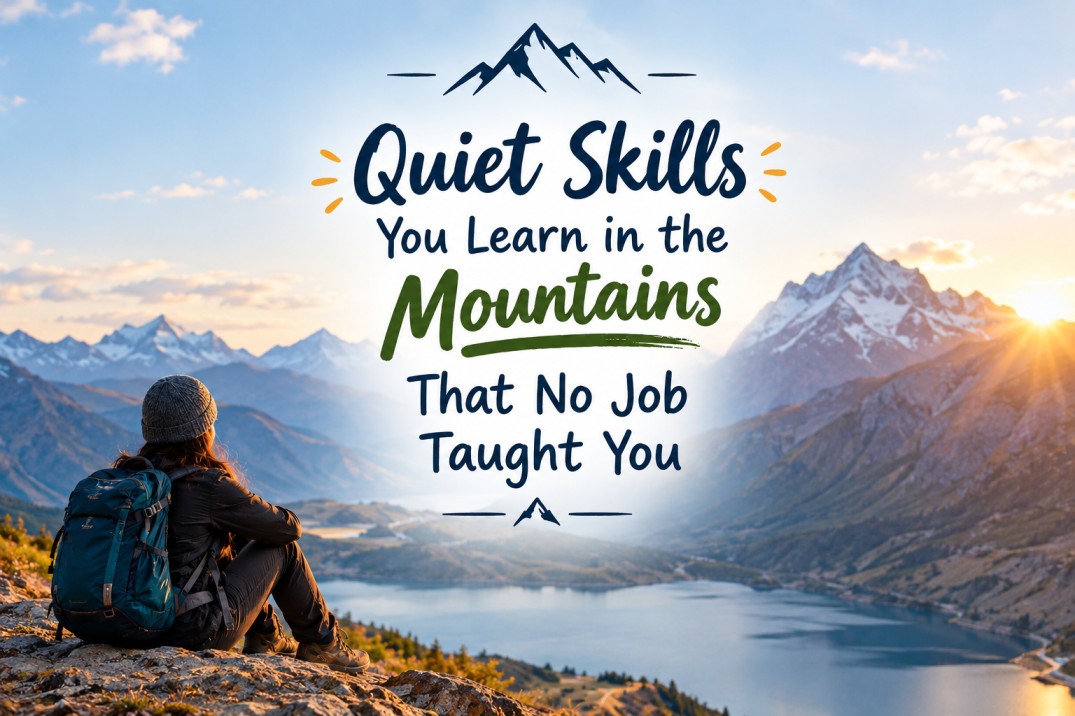
There is something powerful about the quiet skills you learn in the mountains. They are not written in any resume. No company trains you for them. No classroom explains them. Yet, once you return from the mountains, you realize you have changed in ways you cannot fully describe. These mountain life lessons stay with you long after the trip ends.
When you walk through the valleys of the Himalayas or sit near the calm waters of Triund, something shifts inside you. The noise of everyday life fades. The mountains do not shout. They teach softly. They teach through silence, slow mornings, long climbs, and cold winds. And in that silence, you start learning skills no job ever taught you.
Let us talk about these quiet skills. They may look small, but they change the way you see life.
Why do mountains teach you patience without saying a word?
In cities, everything moves fast. Deadlines, meetings, notifications, traffic lights. We are always rushing. But in the mountains, you cannot rush.
When you trek towards Kedarkantha or climb higher in Spiti Valley, you quickly understand one thing: speed does not help. Your breath controls your pace. If you walk too fast, you get tired. If you push too hard, your body protests.
The mountains quietly teach you patience.
You learn to take one step at a time. You learn that reaching the top is not about racing others. It is about steady effort. You begin to respect time rather than fight it. And this patience slowly enters your daily life too. Over time, stressful situations become easier to handle. Instead of reacting immediately, you learn to pause, think clearly, and respond with greater calm.
No corporate training teaches patience like a long uphill climb.
How do mountains teach you to listen more than you speak?
In daily life, we talk a lot. We explain, argue, defend, and impress. But in the mountains, there is no audience to impress.
Sit alone near the river in Tirthan Valley or watch the sunrise from Tiger Hill. You will notice something interesting. You start listening.
- You listen to the wind moving through trees.
- You listen to birds you cannot see.
- You listen to your own thoughts.
One of the most important quiet skills you learn in the mountains is deep listening. Not just to nature, but to yourself and to others. When you travel with friends on a trek, you talk less and observe more. You notice when someone is tired. You understand when someone needs silence.
This skill improves relationships in real life, too. You become more aware. More present. More understanding.
And this is a skill no office workshop can truly teach.
Why do mountains make you comfortable with uncertainty?
In cities, we plan everything. We check weather apps, book hotels, and schedule meetings. But in the mountains, plans often change.
- Maybe the weather turns cloudy near Munsiyari.
- Maybe the road closes near Ladakh.
- Maybe your trek gets delayed.
At first, this feels uncomfortable. But slowly, you learn to adjust. You understand that nature has its own timing. The mountains teach flexibility. They teach acceptance. They teach that not everything is under your control.
This quiet skill is powerful. In life, things do not always go as planned. Jobs change. People change. Situations shift. When you have learned acceptance in the mountains, you handle these changes calmly.
You stop fighting reality. You start adapting to it.
How do mountains build real confidence instead of loud confidence?
There are two types of confidence. One is loud. It shows off. It wants approval. The other is quiet. It is steady and strong.
When you complete a trek in the Valley of Flowers or reach a high pass in Sikkim, no one may clap for you. There may be no big crowd. Maybe just you, your backpack, and the open sky. But inside, you feel something solid. There is a quiet sense of achievement when you complete something difficult, push beyond your limits, and handle moments of discomfort. Each challenge reminds you that you are capable of more than you once believed.
This is real confidence.
The quiet skills you learn in the mountains include trusting yourself. You start believing that if you can survive cold nights, long walks, and simple living, you can handle life’s problems too.
This confidence does not need validation. It quietly supports you in interviews, tough conversations, and new beginnings.
Why do mountains teach you simplicity better than any minimalism book?
In cities, we collect things. Clothes, gadgets, shoes, decorations. We feel we need more to feel happy.
But try packing for a trek to Kasol or camping near Chopta. You carry only what you truly need. A few clothes. Basic food. Water. A sleeping bag. And you survive. In fact, you feel lighter.
The mountains teach you that happiness does not need excess. A warm cup of tea tastes better after a long hike. A simple meal feels special. A small tent feels like home. This skill of simplicity slowly changes your lifestyle. You start valuing experiences over objects. You stop chasing unnecessary things.
No job description includes “learn to live with less.” But the mountains teach it naturally.
How do mountains help you understand teamwork without meetings?
In offices, teamwork is often discussed in presentations. But on a trek, teamwork becomes real. Near Hampta Pass, the group naturally looks after one another. When someone feels tired, everyone slows down, and water is shared if anyone forgets to carry enough. Crossing a narrow path can also feel easier when others offer encouragement and support. These moments teach you that success is not always individual; sometimes, the greatest achievements are shared.
The quiet skills you learn in the mountains include cooperation without ego. No one cares about job titles. No one competes for attention. Everyone just wants to reach safely.
This simple understanding improves how you work with others back home. You become less competitive and more supportive.
Why do mountains improve your decision-making skills?
In high places like Auli or remote regions like Zanskar Valley, small decisions matter.
- Should you continue walking or rest?
- Should you take the longer safe route or the shorter risky one?
- Should you start early or wait for better weather?
You learn to observe before acting by checking the sky, feeling the wind, and listening carefully to local guides. These simple habits teach you to slow down, pay attention to your surroundings, and make thoughtful decisions.
This improves your judgment. You stop making rushed decisions. You start thinking clearly.
These mountain life lessons quietly sharpen your mind.
How do mountains teach gratitude most simply?
In daily life, we often take comfort for granted. Electricity. Hot water. Fast internet. But when you spend nights in remote areas of Arunachal Pradesh or simple villages in Uttarakhand, you see life differently.
You see people living with fewer resources but smiling widely. You appreciate clean air. Fresh water. A safe path. Gratitude grows naturally in the mountains. And once you return, you value small comforts more. You complain less. You thank more.
Why do mountains reconnect you with yourself?
Perhaps the most important of the quiet skills you learn in the mountains is self-awareness. Away from social media, away from constant noise, you finally meet yourself.
While watching snow peaks in the Kumaon or walking alone in the forest trails of Meghalaya, you start asking simple questions:
- What truly matters to me?
- What makes me happy?
- What do I want from life?
The mountains do not answer directly. They just create space for you to think. And sometimes, that space is all you need.
What happens when you return from the mountains?
You return to the same city. Same job. Same routine. But something inside you feels different.
- You walk a little slower.
- You react a little softer.
- You think a little deeper.
The quiet skills you learn in the mountains are invisible, but they shape your character. They make you calmer, stronger, and kinder.
These skills may not appear on your resume. But they improve how you lead, how you love, and how you live.
Final thoughts
The mountains do not promise luxury. They do not offer quick rewards. They offer something far more valuable—they offer growth without noise. Whether you travel to the Himalayas, explore a silent valley, or hike a simple hill near your home, pay attention to what the mountains are teaching you. At Mountain Girl Diary, we believe these quiet moments can become some of life’s most meaningful lessons. Because sometimes, the most important education does not happen in offices or classrooms; it happens on mountain trails, in peaceful valleys, and within ourselves.
It happens quietly, one step at a time, on a mountain path.